
Twist Lock vs Direct Insertion Nail Drills: A Complete Guide to Bit Security and Performance
When choosing a nail drill, most buyers focus on RPM, torque, or motor type. However, one critical detail is often overlooked: how the nail drill bit is secured inside the handpiece.
Bit security directly affects vibration, control, safety, and long-term comfort. In professional use, an unstable bit can lead to uneven filing, hand fatigue, or even injury.
Today’s nail drills mainly use two systems: direct insertion and twist lock. While both are common, they are designed for very different usage scenarios.
This guide explains how each system works, their advantages and limitations, and how to choose the right option based on real nail service needs.
What Is a Direct Insertion Nail Drill?
A direct insertion nail drill uses a friction-based mechanism. The drill bit is pushed straight into the handpiece and held in place by internal pressure components such as springs or sleeves.
There is no locking action—once inserted, the bit stays in position through internal tension.
This system is commonly used in:
Entry-level nail drills
Lightweight portable models
Home-use or beginner-focused devices
Advantages of Direct Insertion
Direct insertion systems remain popular because they are:
Simple and fast to use, with no learning curve
Cost-effective, thanks to fewer internal parts
Lightweight, reducing hand strain for short sessions
For basic tasks such as cuticle prep, surface refinement, or occasional gel removal, direct insertion performs adequately.
Limitations of Direct Insertion
However, direct insertion has clear limits:
Weaker bit retention at high torque
More vibration at higher speeds
Less suitable for long or intensive sessions
When used for acrylic or hard gel removal, the bit may loosen over time, reducing precision and comfort.
What Is a Twist Lock Nail Drill?
A twist lock nail drill secures the bit using a mechanical locking mechanism. After inserting the bit, the user rotates a collar on the handpiece, tightening an internal clamp around the bit shank.
This creates a firm, centered hold that remains stable even under high torque and RPM.
Twist lock systems are typically found in:
Professional salon nail drills
High-torque or high-speed models
Devices designed for acrylic and hard gel services
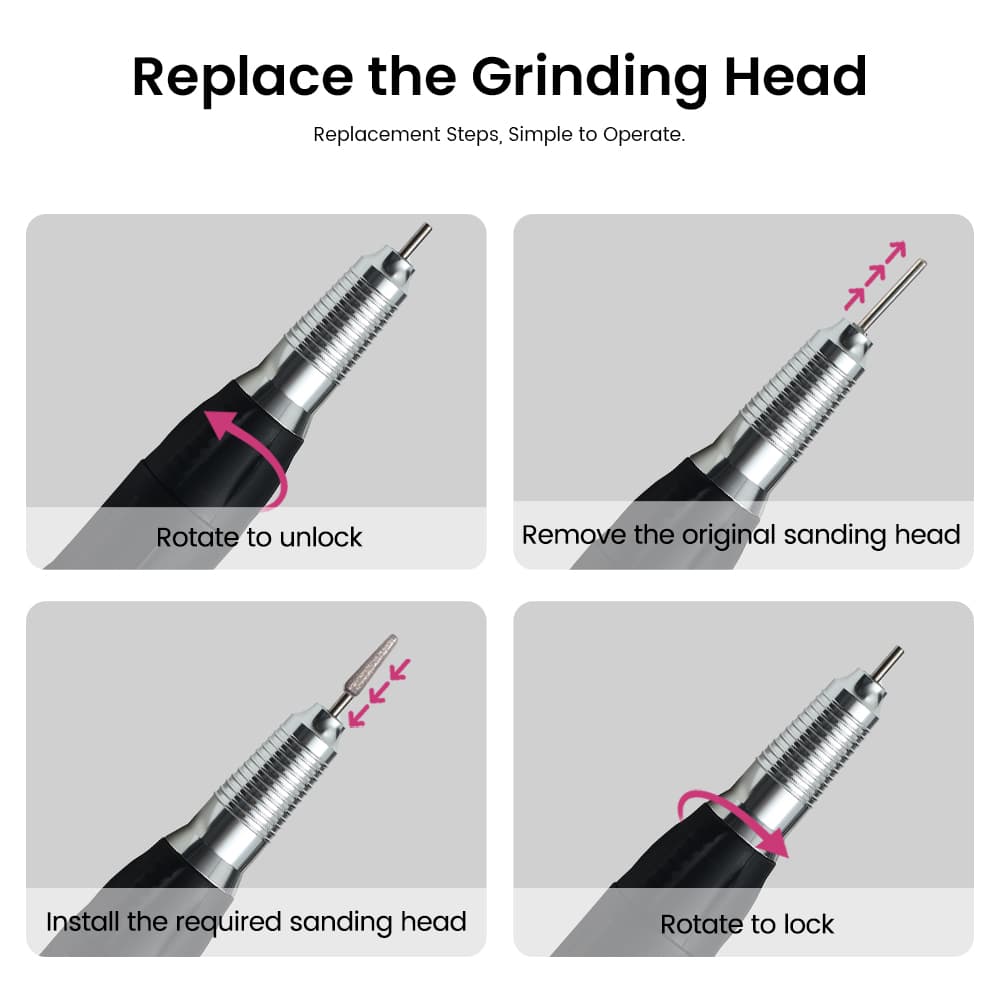
Advantages of Twist Lock Systems
Twist lock handpieces offer several performance benefits:
Stronger bit fixation, reducing slippage
Minimal vibration, even at high speeds
Improved safety and control
Better compatibility with powerful motors
These advantages make twist lock the preferred choice for daily professional use.
Potential Drawbacks
The main considerations with twist lock systems include:
Slightly higher manufacturing cost
The need to fully engage the locking mechanism
In practice, these are minor trade-offs for the stability gained.
Direct Insertion vs Twist Lock: Key Differences
| Feature | Direct Insertion | Twist Lock |
|---|---|---|
| Bit security | Medium | High |
| Vibration control | Basic | Excellent |
| Torque tolerance | Low–Medium | Medium–High |
| Learning curve | Very low | Low |
| Best use case | Home & beginners | Professional salons |
| Acrylic removal | Limited | Highly suitable |
This comparison shows why twist lock dominates professional environments, while direct insertion remains popular for entry-level use.
Which System Is Right for You?
Beginners and Home Users
For beginners or occasional users, direct insertion offers:
Easy operation
Lower upfront cost
Sufficient performance for light tasks
It is ideal for users who prioritize simplicity over power.
Professional Nail Technicians
For salon professionals, twist lock systems are usually the better choice:
Stable operation during long sessions
Reduced hand fatigue due to smoother rotation
Greater confidence when working at high speed
Consistency and control matter more than simplicity in professional settings.
Acrylic and Hard Gel Removal
Acrylic and hard gel removal demand:
High torque
Secure bit fixation
Minimal vibration
In these scenarios, twist lock systems clearly outperform direct insertion.
How to Secure Nail Drill Bits Correctly
Even the best handpiece can underperform if the bit is installed improperly.
Common Mistakes
Inserting the bit only partially
Not fully locking the twist mechanism
Using incompatible shank sizes
Continuing to use worn or bent bits
Any of these can cause vibration or instability.
Best Practices
Always check bit tightness before use
Clean the handpiece regularly to prevent dust buildup
Replace worn internal components when necessary
Proper installation and maintenance significantly extend tool lifespan.
Bit Compatibility and Industry Standards
Most professional nail drills are designed around the 3/32-inch shank standard, allowing compatibility with the majority of nail drill bits on the market.
This standardization is especially important for:
Salons using multiple drill brands
Distributors sourcing machines and bits separately
OEM and private-label nail drill projects
A high-quality handpiece should maintain consistent grip on standard shank sizes without excessive wear.
Choosing a Nail Drill for Brands, Salons, and Distributors
Different markets prioritize different features:
Consumer markets value simplicity and affordability
Professional markets prioritize durability, torque, and stability
This is why many manufacturers offer both direct insertion and twist lock models within their product ranges.
From an OEM or wholesale perspective, the bit locking system affects:
Product positioning
Pricing strategy
Target user profile
Matching the locking system to the intended user is essential for long-term product success.
Frequently Asked Questions
Is twist lock safer than direct insertion?
Yes. Twist lock provides stronger mechanical fixation, especially at high speed or torque.
Do all bits fit twist lock handpieces?
Most twist lock handpieces support standard 3/32-inch shank bits.
Can beginners use twist lock nail drills?
Yes. Once the locking motion is understood, twist lock is very user-friendly.
Why does my bit feel loose during use?
Common causes include incomplete locking, worn components, or incompatible bit sizes.
Conclusion
Direct insertion and twist lock nail drills serve different purposes.
Direct insertion offers simplicity and accessibility, making it suitable for beginners and light use. Twist lock systems deliver superior stability and performance, making them the preferred choice for professional nail technicians and demanding services like acrylic removal.
Understanding these differences allows users—and brands—to choose nail drills that truly match real working conditions.