How to Choose the Best Nail Drill in 2026 | Professional Buying Guide
Introduction
Choosing the right nail drill machine has become more complex in 2026 than ever before. With hundreds of models on the market promising high RPM, ultra-quiet motors, smart controls, and “professional results,” it is increasingly difficult for nail technicians, salon owners, and distributors to distinguish meaningful performance from marketing claims.
A nail drill is not just a tool — it directly affects service quality, client comfort, technician health, and long-term operating costs. The wrong choice can lead to excessive vibration, heat buildup, noise, frequent breakdowns, or even nail damage. The right choice, however, improves efficiency, precision, and customer satisfaction while reducing fatigue and maintenance.
This guide explains how to choose the best nail drill in 2026 by focusing on real performance factors: power, RPM, torque, motor type, vibration, ergonomics, and long-term reliability. Whether you are a professional nail technician, salon owner, beauty school manager, or distributor, this article will help you make an informed, future-proof decision.
Who This Guide Is For
This guide is designed for:
Professional nail technicians working daily with acrylic, gel, and builder products
Salon owners upgrading or standardizing equipment
Beauty schools selecting training equipment
Distributors and importers evaluating OEM/ODM suppliers
Serious home users seeking professional-grade performance
1. Power (Wattage): The True Foundation of Performance
Power is the most misunderstood specification in nail drills. Many buyers focus on RPM alone, but power (measured in watts) determines whether the drill can maintain speed under load.
A drill with high RPM but low wattage will slow down, vibrate, or overheat when working on thick gel, acrylic overlays, or removal services.
Recommended Power Levels
Home or occasional use: 20–25W
Professional salon use: 30–60W
Heavy-duty or high-volume salons: 60W+
Higher wattage provides stronger torque, smoother operation, and less stress on the motor.
2. RPM: Speed Matters, But Only with Enough Power
RPM (revolutions per minute) determines how fast the bit spins. In 2026, most professional nail drills offer between 25,000 and 40,000 RPM.
For basic manicure and prep: 15,000–20,000 RPM is sufficient
For acrylic removal, hard gel, and bulk work: 30,000 RPM or more is recommended
However, RPM without torque is meaningless. A high-RPM, low-power drill will stall and generate heat under pressure, increasing the risk of discomfort or nail damage.
3. Torque: The Missing Specification
Torque is the ability of the drill to resist slowing down under load. While rarely advertised, it is one of the most important real-world performance indicators.
High torque means:
Consistent speed
Less pressure required
Reduced vibration
More precise control
When comparing drills, higher wattage and brushless motors generally indicate higher torque capability.
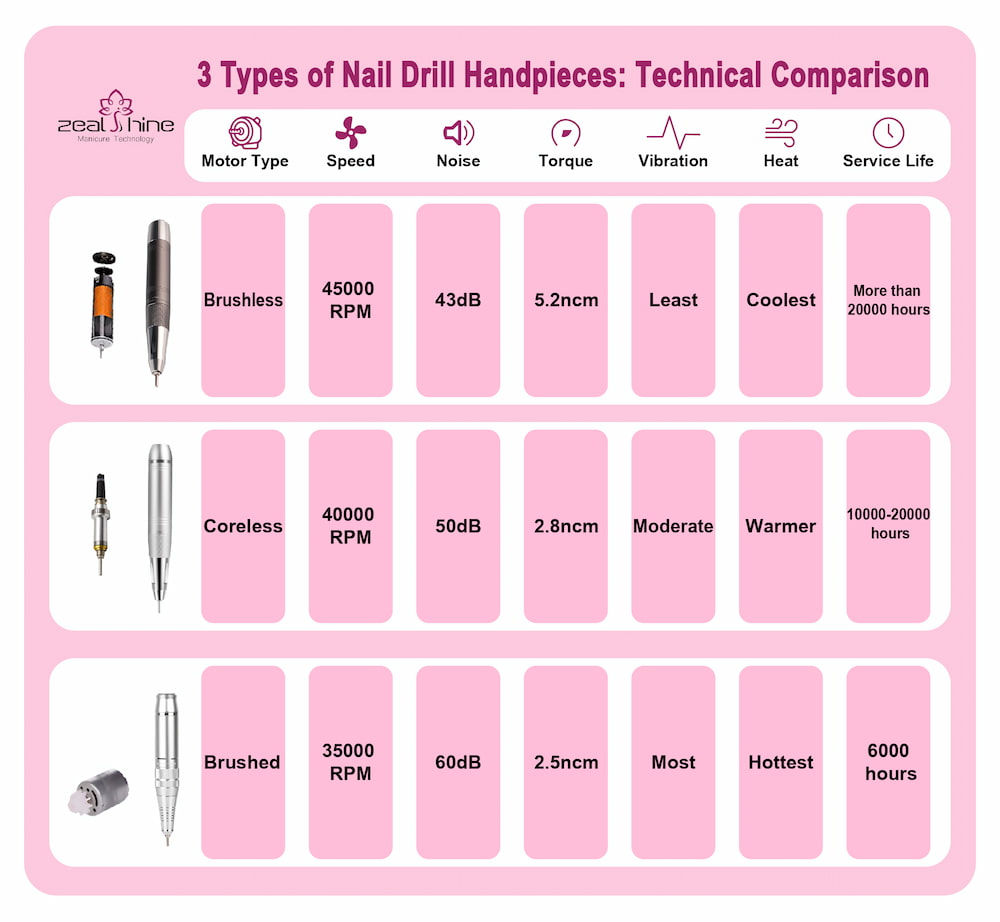
4. Brushless vs Brushed Motors
Motor type significantly affects noise, lifespan, heat, and maintenance.
Brushed Motors
Lower cost
Higher noise and heat
Shorter lifespan
Require brush replacement over time
Brushless Motors
Quieter operation
Lower heat generation
Longer lifespan (often 3–5× longer)
Minimal maintenance
For professional and commercial use in 2026, brushless motors are strongly recommended.
5. Vibration and Noise: Comfort Is Performance
Excessive vibration reduces precision and causes hand fatigue. Over time, it can lead to wrist and joint issues for technicians.
Low-vibration drills:
Improve fine control
Reduce technician fatigue
Feel smoother to clients
Similarly, low-noise operation improves salon ambiance and client comfort, especially in premium or spa-like environments.
6. Handpiece Ergonomics and Weight
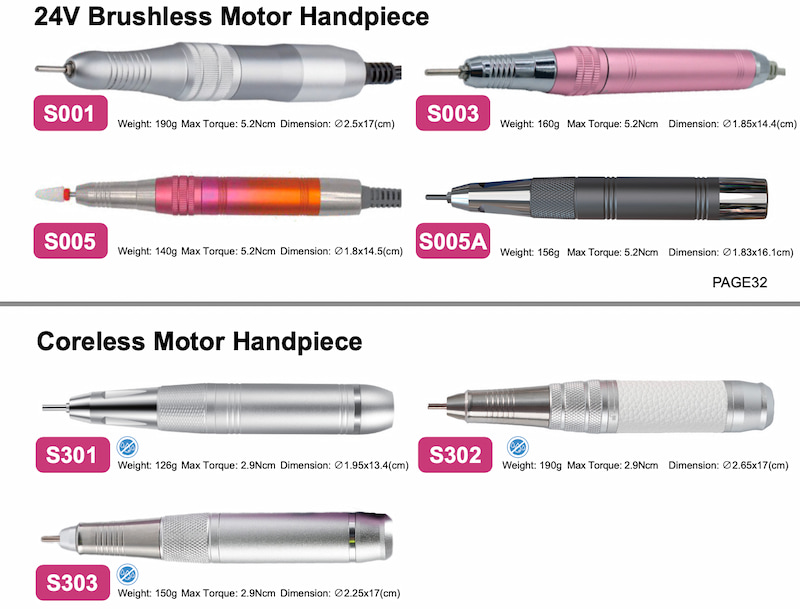
The handpiece should be:
Lightweight (ideally under 160g)
Well balanced
Comfortable for long sessions
Poor ergonomics can lead to hand strain, decreased accuracy, and reduced work speed.
7. Forward and Reverse Rotation
Forward and reverse rotation allows comfortable use for both left- and right-handed technicians and supports different filing techniques. This feature is essential for professional environments.
8. Bit Compatibility and Standards
The industry standard bit size is 3/32 inch (2.35 mm). Using a standard size ensures:
Easy sourcing of bits
Lower accessory costs
Compatibility with global suppliers
Avoid proprietary or uncommon sizes unless absolutely necessary.
9. Heat Management and Safety
Heat buildup affects both comfort and equipment lifespan. High-quality drills use:
Efficient motor design
Aluminum housings for heat dissipation
Internal cooling systems
A cool-running drill improves comfort and reduces long-term wear.
10. Durability, Certification, and After-Sales Support
For commercial use, always verify:
CE, FCC, or regional certifications
Warranty coverage
Availability of spare parts
Technical support from the manufacturer
These factors reduce downtime and protect your investment.
Common Mistakes When Choosing a Nail Drill
Choosing based on RPM alone
Ignoring power and torque
Overlooking vibration and ergonomics
Buying the cheapest option for professional use
Ignoring certifications and service support
Quick Recommendation by User Type
| User Type | Recommended Specs |
|---|---|
| Home User | 20–25W, 20k RPM, brushed |
| Professional Technician | 35–60W, 30k RPM, brushless |
| High-Volume Salon | 60W+, 35k RPM, brushless |
| Distributor / Importer | Brushless, certified, ODM support |
Final Thoughts
In 2026, the best nail drill is not the one with the highest RPM or the lowest price — it is the one that delivers consistent power, low vibration, thermal stability, ergonomic comfort, and long-term reliability.
By focusing on real performance metrics rather than marketing claims, you can choose a drill that improves service quality, protects technician health, and delivers long-term value for your business.
A good nail drill is an investment — not just in equipment, but in your service standard, reputation, and operational efficiency.
FAQ
Q: Is 35,000 RPM better than 30,000 RPM?
Not necessarily. Without sufficient torque and power, higher RPM offers little benefit.
Q: Are brushless drills worth the higher cost?
Yes. They last longer, run cooler, and require less maintenance, making them more economical long term.
Q: Can one drill handle both manicure and pedicure?
Yes, if it has sufficient power, torque, and proper bit compatibility.