Nails That Light Up: Why Your Gel Isn’t Curing and How to Fix It
When you place your hand under a gel lamp, your nails usually “light up” — reflecting the bright LEDs and creating a glossy glow. Many people assume that this brightness means their gel polish is curing correctly. But in reality, light ≠ curing, and thousands of nail users experience soft, sticky, or wrinkled gel even though the lamp looks bright.
If you’ve ever found yourself asking:
Why isn’t my gel polish curing?
Why isn’t my gel curing even though the lamp looks strong?
Is my LED nail lamp producing no UV even if it lights up?
…then this in-depth guide is for you.
Below, you’ll learn why gel doesn’t harden, how to troubleshoot curing issues, how to fix lamps that light up but won’t cure, and when it’s time to upgrade to a reliable professional UV/LED lamp.
What “Nails That Light Up” Really Mean Under a Gel Lamp
Brightness Doesn’t Equal UV Output
Seeing your nails glow brightly under the lamp is totally normal — it simply means the light is reflecting off your nail surface. But this brightness only indicates visible light output, not the UV wavelengths needed to trigger polymerization.
This leads to a misleading scenario:
Your LED lamp looks bright, but there is little to no UV output.
This is one of the most common reasons users encounter LED nail lamp no UV issues.
Why Light-Up Nails Don’t Guarantee Proper Curing
Gel doesn’t react to brightness. It reacts to specific UV wavelengths between 365–405 nm.
Without these wavelengths, even the brightest lamp cannot cure gel.
This is why many users ask:
Why isn’t my gel curing even though the lamp looks fine?
Answer: visible light ≠ curing wavelengths.
Common Reasons Why Your Gel Polish Isn’t Curing
Below are the most common technical and user-related reasons.
1. Insufficient UV/LED Wavelength Output
Gel polish requires UV wavelengths in the 365–405 nm range.
If your lamp cannot produce these wavelengths — due to aging bulbs, damaged chips, or weak construction — your gel will stay soft or sticky.
This is the #1 cause for why isn’t my gel polish curing.
2. Gel Formula Not Compatible With Your Lamp
Different gels require different curing strengths:
Soft gel: usually easy to cure
Hard gel / builder gel: needs high wattage + dual-wave LEDs
Some gel brands only cure under UV, not LED
A lamp with limited wavebands cannot cure advanced formulas.
3. Applying Gel Too Thick
Thick layers trap UV light and prevent complete polymerization.
Even the strongest lamps cannot cure heavily applied layers.
4. Dirty Reflectors or Blocked Light Paths
Dust, acetone residue, and nail debris inside the lamp reduce UV exposure.
Reflectors help distribute light evenly, and when blocked, nails cure unevenly.
5. Timer or Sensor Failure
Sometimes, the lamp lights up visually, but the internal UV driver never activates.
This creates the perfect scenario where nails “light up,” but the gel remains uncured.
How to Troubleshoot When Nails Light Up but Gel Doesn’t Cure
Below are simple and advanced tests you can perform at home.
Step 1 — Test Actual UV Output
Use a UV test card or place a thin clear gel layer on a swatch stick.
If it stays wet or rubbery after 60 seconds:
Your lamp either outputs weak UV
Or it outputs no UV despite lighting up
Step 2 — Switch Gel Brands to Check Compatibility
Try curing a thin base gel from a reputable brand.
If it still doesn’t cure, the lamp is the problem — not the gel.
Step 3 — Clean the Inside of the Lamp
Wipe reflectors and lamp beads with alcohol to remove oils and dust.
Step 4 — Inspect the Power Adapter
Weak power supply = weak UV output.
Many curing issues come from low-voltage adapters, especially 12V ones that degrade over time.
Advanced Technical Reasons Why Gel Isn’t Curing Properly
For salon owners and professionals, these deeper factors may apply.
Waveband Mismatch (365–405 nm)
Older LED lamps may only emit 405 nm, while modern gel formulas require 365 nm as well.
This mismatch is a major reason for gel staying soft even when fully cured by time.
LED Driver Failure
The driver is the component that powers UV chips.
A failing driver may:
Light the LEDs visually
But fail to activate UV wavelengths
This results in the illusion of a working lamp when it’s not curing at all.
Overheating Protection Mode
Some lamps reduce power when they get too hot, limiting UV strength mid-session.
How to Fix a Lamp That Lights Up but Doesn’t Cure Gel Properly
Not all lamps can be saved, but try these steps:
Replace LED Chips or the Driver Board
If the visible LEDs work but UV chips are dead, replacing the board can help — but this is only practical if you’re technically skilled.
Replace the Power Adapter
A weakening adapter is one of the cheapest and fastest fixes.
Upgrade to a Higher-Wattage Dual-Wave Lamp
Builder gel, rubber base, and thicker coats require high output lamps.
If your lamp is under 36W, curing issues are expected.
A Better Solution: Use a High-Performance Dual-Wavelength Lamp
After troubleshooting hundreds of curing issues, most professionals eventually discover:
👉 The problem usually isn’t the gel.
👉 The problem is the lamp’s waveband stability.
Modern dual-wavelength lamps use both 365 nm and 405 nm, ensuring compatibility with:
Base gel
Color gel
Top coat
Builder gel
Soft gel & hard gel
They also offer more stable curing than older single-wave models.
Example of a Reliable Dual-Wave Lamp
If your current lamp lights up but fails to cure properly, upgrading to a well-designed dual-wave lamp makes a huge difference.
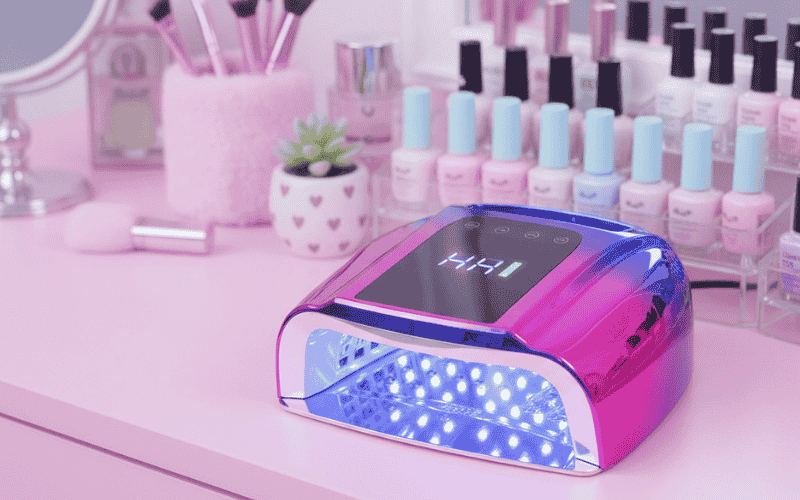
For example, the Powerful Nail UV LAMP offers:
365–405 nm dual-wave curing
Strong and stable output for all gel types
Portable design for salons, mobile techs, or home use
Fast curing times even for thicker formulas
Better compatibility with modern gel brands
Prevention Tips for Perfectly Cured Gel Nails Every Time
1. Use Lamps with Real 48W–120W Output
Not “fake wattage” models that exaggerate numbers.
2. Apply Thin, Even Gel Layers
Thick gel cures poorly regardless of lamp quality.
3. Maintain and Clean Your Lamp Regularly
Dust and oil block UV strength.
4. Choose a Dual-Wave Lamp for Maximum Compatibility
This ensures your gel cures properly across all formulas.
Conclusion
“Nails that light up” under a lamp simply show visible brightness — not curing power.
If your gel stays soft, sticky, or wrinkled, the real issue is almost always:
Weak or unstable UV output
Bad waveband compatibility
Thick gel application
Aging or damaged LEDs
Poor-quality power adapter
Or a lamp that produces brightness but no true UV
To avoid these problems:
Troubleshoot your current lamp
Apply gel properly
Keep your lamp clean
And when needed, upgrade to a stable, dual-wavelength curing lamp like the ZSDQL02 for professional results.
With the right tools and techniques, you’ll get perfectly cured gel nails every single time.